4
Subject tests
Your child has one test in each of the four core areas. Spread them across the week, with feedback afterwards.
A calmer way to prepare for 11+
Weekly tests, short practice and writing challenges, with feedback that helps your child know what to try next.
For children preparing for 11+ entry to secondary school. £10 a month, including Writing Academy.
Already with FPA? Sign in
20 questions · around 10–20 minutes · no payment details
We’ll email you a clear result and one useful next step. The Diagnostic is free; joining is always your choice.
Included for £10 a month per child
Four subject tests, with games and writing when you want extra practice. Spread the activities across the week.
4
Your child has one test in each of the four core areas. Spread them across the week, with feedback afterwards.
3
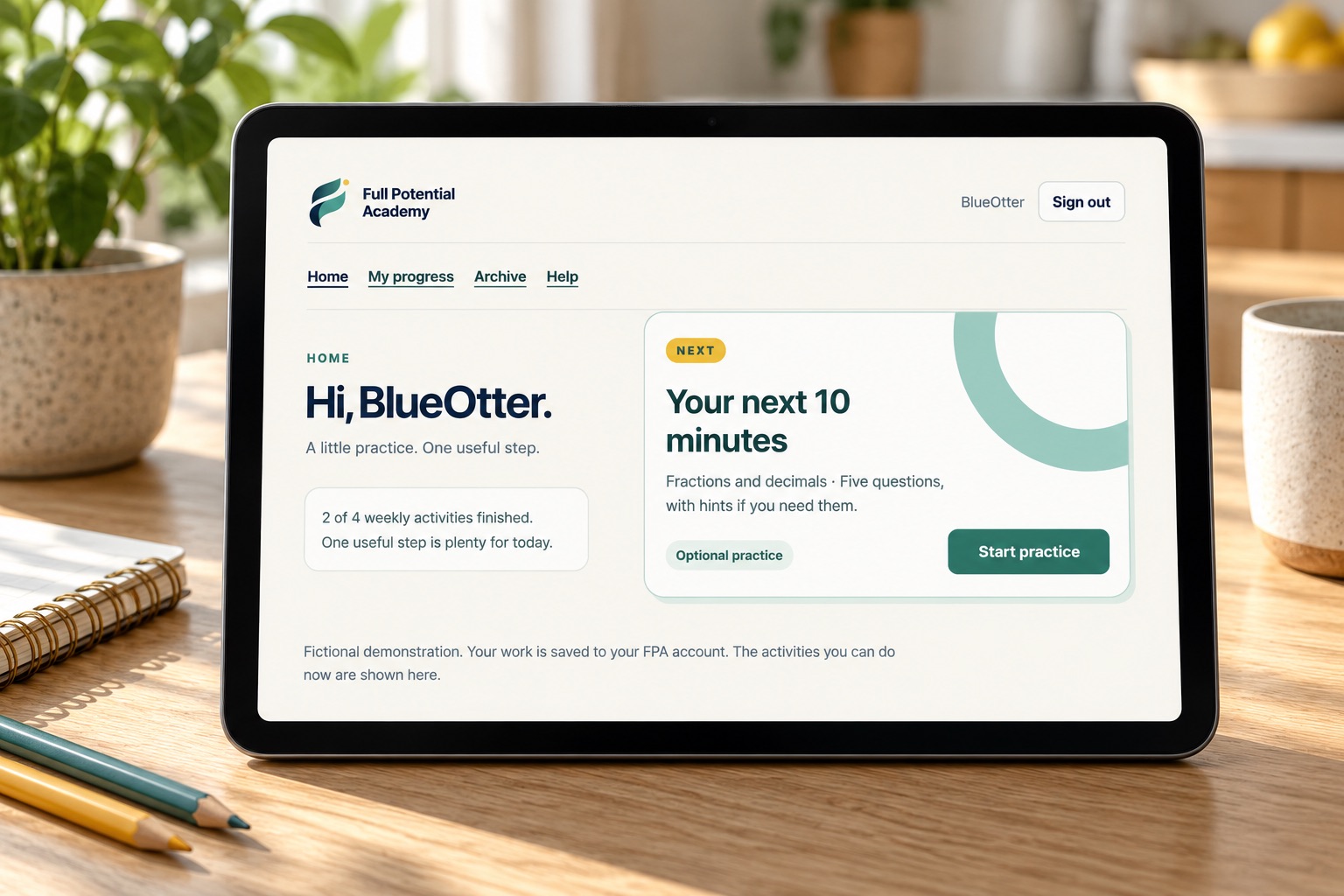
Five questions in each, with hints when needed. There’s more short practice to explore too.
1
Write independently or use ideas and sentence starters. Typed or handwritten. During beta, FPA’s founder checks feedback before it reaches your child.
Your part as a parent: help your child get set up, find a quiet moment and look at the feedback together. Let them answer the tests independently; hints are available during optional practice.
No daily target, points or streak to protect. Start with one activity and come back when it suits your family.
Membership also includes a fuller baseline, taken one subject at a time. The free Diagnostic is a short starting snapshot, not an exam prediction.
More about the weekly programme →Why families choose FPA
No streaks to keep alive. No points or fireworks for one right answer. Just thoughtful practice, useful feedback and room to build confidence at your child’s pace.
Explore three examples from the FPA platform. On a phone, swipe to see each one.
A first look
You found the matching fractions.
The free Diagnostic shows what feels comfortable and what may need another look. It gives you a starting point, not a label.
Try the free Diagnostic →Fractions and decimals
What is three quarters of 20?
I’ll try one quarter first.
Short practice offers an explanation and a checked hint when it’s useful. Try a few questions, then stop or come back later.
See how practice works →A quick look
See what your child’s own work shows and what may help next. There are no leaderboards, rankings or comparisons with other children.
A little more for parents →Weekly tests show what your child can do independently. Optional practice is where hints are available. Both have a place.
Take a look inside
Four weekly tests, with optional practice when it helps. Spread the work across the week; there’s no daily target.
Have a look for yourself. These sample screens are demonstrations. They are not scored or saved.
Pick a subject, think about your answer, then open the explanation. These examples give you a taste of the questions — the free Diagnostic is a separate starting point.
Try a question first
Four examples made for this page, with answers you can open when you’re ready. They are not Diagnostic questions, and nothing here is scored or saved. They show a few question types, not the full range of difficulty.
A small cinema has 28 seats. Three quarters of them are occupied. How many people are sitting down?
A: 7 B: 14 C: 21 D: 24
C: 21 people. One quarter of 28 is 7. Three quarters is three lots of 7: 21. Find one part first, then take the number of parts you need.
Noah tore open the envelope. He read the first line, stopped, then read it again. A grin spread across his face. He held the letter above his head and ran into the kitchen.
How does Noah probably feel at the end?
A: Pleased B: Bored C: Disappointed D: Frightened
A: Pleased. His grin and the way he runs to share the letter suggest good news. “Probably” matters: we are using clues in the writing, rather than being told exactly how he feels.
Which word is closest in meaning to reluctant?
A: Tired B: Unwilling C: Careless D: Hasty
B: Unwilling. If you are reluctant to do something, you do not really want to do it. Try swapping the words in a sentence: “He was reluctant to go” becomes “He was unwilling to go.”
Each arrow turns a quarter-turn clockwise. Which arrow comes next?
B: Left. Up turns to right, right turns to down, and down turns to left. Keep the direction and size of each turn the same.
Ready for a first look? The free Diagnostic has 20 questions across these four areas.
Start the free DiagnosticSample parent email
6 out of 10 · 60% correct
Illustrative score only; this is not the length of an FPA weekly test.
Your child found three quarters of 28 correctly. Finding one quarter first gave them a useful starting point.
Try three quarters of 20 together. Ask, “What is one quarter?” before moving on to three. A few minutes is enough.
The feedback helps you decide what to look at together. We’ll tell you what the work shows, without turning one result into a verdict.
The real update uses your child’s completed work. It does not predict an exam result or school place.
How feedback helps parents →Writing Academy has its own example of a writing challenge and one useful improvement.
See the writing example →Thinking about schools?
Explore 246 schools. These six have checked test guides; other listings are clearly marked while we check their details.
Scroll to explore · School names are for information, not endorsements. Saving choices does not change the weekly tests.
20 questions across the four core subjects, taking around 10–20 minutes. We email you a result with something your child did well and a useful next step. It is a first look, not a prediction of an exam result or an automatically generated study plan. Try the free Diagnostic.
No. Your child has one test in each of the four core subjects each week. Spread them out to suit your family. Optional games and writing are there for a little extra practice, not another list of jobs to finish.
Membership for one child: the weekly programme, optional Skill Practice and Writing Academy, including the current beta features. You can try the free Diagnostic before deciding; there is no free membership trial. See membership details.
FPA builds skills used across different 11+ tests. It does not reproduce every school’s paper. Find your school and check its own admissions information. Our finder clearly separates checked test guides from school listings whose details still need checking.
One manageable weekly routine. Four core 11+ subjects. Clear feedback to help you decide what to practise next.